


Many challenges that our customers face can be solved with a cobot and a gripper. However, depending on the individual needs of the manufacturer and their process, a wide array of end-of-arm tooling options is available. These include electric grippers, pneumatic and vacuum grippers (Figure 2), wrist cameras, vision systems, and dispensing, palletizing, machine tending, welding and screwdriving options. Electric grippers are the most popular tooling option for some common cobot applications, including machine tending and pick and place. They typically come in two- and three-jaw configurations, offering precise control that allows you to vary your grip force, speed and position. This lets them handle different part types with ease. Pneumatic grippers use pressure from a compressed air supply to open and close the gripper fingers. Since most manufacturing facilities have access to compressed air already, deploying pneumatic grippers is easy and cost-effective. The largest benefit of these grippers is that they can provide a high amount of gripping force in a small package. Vision systems consist of 2D or 3D cameras that give the cobot vision. They allow the robot to locate objects, recognize patterns or scan barcodes. This may eliminate the need to present parts to the robot in a structured way since it can locate objects on its own. Vision systems also help the cobot carry out optical inspections, e.g., checking parts for defects. Dispensers are end-of-arm tools that uniformly dispense liquids. The most common applications for dispensers are gluing and sealing. These are perfect cobot applications because of the monotonous and repetitive nature of the work. A dispenser ensures you always use the same amount of product in the same way, reducing errors and waste. Standard, built-in path planning software tools enable a user to quickly implement dispensing about a unique 3-D path for the part contour needed.
Screwdrivers are a niche solution, but we are seeing more of them. Recently, our team at Motion Ai automated several applications that required this EOAT type. Our screwdriver version comes with all the software and hardware needed to automate this mundane task. Today’s screwdriving solutions are smaller and less complex than their predecessors, making them viable for manufacturers of all sizes.
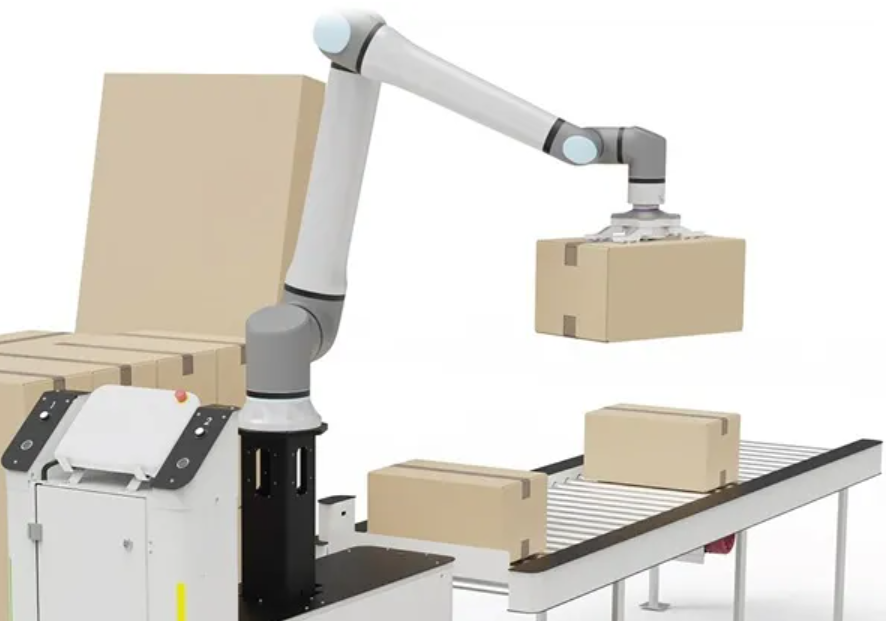
Palletizing solutions are the ideal answer for many projects for our customers. Motion Ai offers an off-the-shelf solution that includes software and hardware to optimize this task that can be especially tedious for human workers. Once the hardware is set up, simply enter your box dimensions, weight and pallet layout into the software, and you can be palletizing in a matter of minutes—with no motion programming necessary (Figure 3).
In both screwdriver and palletizing solutions, the main benefit is ergonomics. Each screwdriver and palletizer installation gets the job done more efficiently and usually faster, allowing workers to take on other, less strenuous tasks.
The ecosystem of products that has developed around collaborative robots means that these days, almost any application can be solved with an existing solution. And if an off-the-shelf solution doesn’t exist, check with your distributor for options. A full-service distributor will have experienced engineers who design custom cobots to solve applications like those listed above, plus a full line of motion control and automation products to complete your automation projects.
BRIEF INTRODUCTION
Cnbearing is the No.1 bearing inquiry system and information service in China, dedicated to helping all bearing users and sellers throughout the world.
Cnbearing is supported by China National Bearing Industry Association, whose operation online is charged by China Bearing Unisun Tech. Co., Ltd.
China Bearing Unisun Tech. Co., Ltd owns all the rights. Since 2000, over 3,000 companies have been registered and enjoyed the company' s complete skillful service, which ranking many aspects in bearing industry at home and abroad with the most authority practical devices in China.