


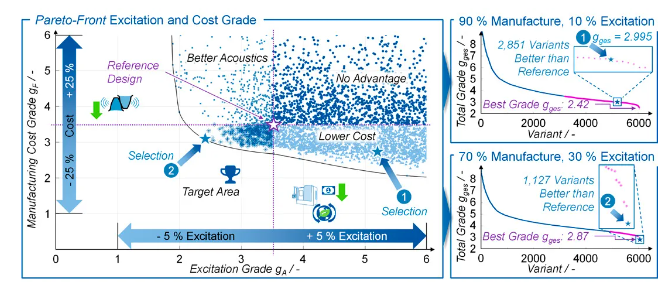
The picture shows the Pareto front determined after n = 20,000 iterations for the opposing grading of production costs (gF) and gear excitation behavior (gA). A population size of npop = 100 particles per iteration was used, whereby the oblivion rate a = 0.1 was parameterized. The mutation rate was set to m = 0.1. In sum, n = 6,042 tolerance designs were identified in a target range that was narrowed down to score values g < 10. Tolerance designs whose manufacturing grade gF < 3.5 (lower costs) are marked as triangles, while optimizations in the excitation are shown with squares. It was also possible to identify various variants that fulfill both aspects better compared to the experience-based reference tolerance design. These are marked with an asterisk. For the grading of the variants in the ranges gA/F = 1…6, the different percentage referring to the reference must be taken into account.
An overall score gges can be determined from the designs close to the Pareto front by parameterizing the weighting factors fA and fF. Depending on the weighting selection, the focus can thus be placed on compliance with the acoustics or on reducing the production costs. In the diagrams in Figure 11 on the right, the best variants with a better (lower) overall score gges are listed in ascending order. Two variants were selected for comparison. One for an increased focus on acoustic, the other on cost reduction. The full identification of the Pareto-Front is an iterative and evolving process, so its characteristics can change as the number of iterations increases.An overall score gges can be determined from the designs close to the Pareto front by parameterizing the weighting factors fA and fF. Depending on the weighting selection, the focus can thus be placed on compliance with the acoustics or on reducing the production costs. In the diagrams in Figure 11 on the right, the best variants with a better (lower) overall score gges are listed in ascending order. Two variants were selected for comparison. One for an increased focus on acoustic, the other on cost reduction. The full identification of the Pareto-Front is an iterative and evolving process, so its characteristics can change as the number of iterations increases.
BRIEF INTRODUCTION
Cnbearing is the No.1 bearing inquiry system and information service in China, dedicated to helping all bearing users and sellers throughout the world.
Cnbearing is supported by China National Bearing Industry Association, whose operation online is charged by China Bearing Unisun Tech. Co., Ltd.
China Bearing Unisun Tech. Co., Ltd owns all the rights. Since 2000, over 3,000 companies have been registered and enjoyed the company' s complete skillful service, which ranking many aspects in bearing industry at home and abroad with the most authority practical devices in China.