The SKF High-Capacity Cylindrical Roller Bearing
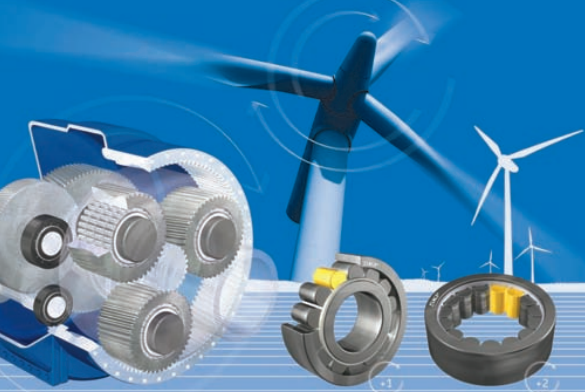
Introduction Th e ISO defi nition of a full-complement bearing states that the bearing does not have a cage. When that defi nition was written, it was not technically possible to have a full-complement bearing with a cage. But SKF’s new high-capacity cylindrical roller bearing combines the load-carrying capacity of a fullcomplement bearing with the benefi ts of a bearing with a cage (Fig.1). History In 1960, when SKF introduced the E-design cylindrical roller bearing, it was seen as an important step in the development of standard cylindrical roller bearings. Th e bearing was based on standardized boundary dimensions; it was the internal macro geometry that made it diff erent from other bearings. SKF engineers had found a way to optimize the number of rollers, the roller size and the thickness of the inner and outer rings, leading to an increased loadcarrying capacity and rated bearing life. In the 1980s, SKF engineers went on to develop the EC design, which had a higher thrust load-carrying capacity, and then the SKF Explorer cylindrical roller bearings, which were launched in 2002. Th e SKF Explorer bearings benefi ted from improved material and an improved heat-treatment process, but it was mainly the improved micro geometry that gave these bearings a competitive advantage. Using knowledge gained over the years, together with proprietary software, engineers were able to maximize the eff ects of the lubricant fi lm build-up and decrease the friction within the bearing.
Load-Carrying Capacity Load-carrying capacity is calculated using formulas in the standards ISO 76 and ISO 281. According to these formulas, there are two ways to increase the load-carrying capacity of a bearing while maintaining standardized boundary dimensions: • Increase the dimensions of the rollers and maintain the same number of rollers; or • Increase the number of rollers and maintain the roller dimensions. From a practical point of view, the fi rst method leads to a technical problem. Increasing the size of the rollers will reduce the thickness of the inner and outer rings and the width of the side fl anges. Th is has no eff ect on the theoretical load-carrying capacity calculation. In reality, however, these changes will reduce ring stiff ness and fl ange strength. For the end user, this means a higher risk of micro movements in the bearing seating, which causes fretting corrosion or ring creep. Larger rollers also increase the risk of smearing damage, due to their higher moment of inertia. All in all, the fi rst method, though impressive on paper, cannot be considered an improvement. Th e second alternative, however, does off er viable alternatives. Based on the former improvements of the macro and micro geometries, the roller dimensions and wall thickness of the bearing rings can remain unchanged, compared with the dimensions of the proven 45-year-old E-design. However, increasing the number of rollers within a defi ned envelope is not as easy as it sounds. To make this new bearing a reality, SKF engineers and scientists needed to work through a number of key issues.
“Add More Rollers”— Easy to Say, Hard To Do Th ere are two types of rolling element bearings: caged bearings and fullcomplement bearings. Full-complement bearings, which do not use a cage, are fi tted with a maximum number of rollers. In this type of bearing, the rollers are in direct contact with each other, which causes sliding and increases friction and heat generation. Under certain circumstances, this leads to wear and premature bearing failure, making them unacceptable for applications where there are higher speeds. Th is makes a cage essential for higher-speed applications. Medium- and large-size cylindrical roller bearings are equipped as standard with a machined brass cage, mainly to keep the rollers from making contact. Th e cage bars, which usually are orientated around the roller pitch circle (the connecting circle of the mid-points of all rollers), have a defi ned cross section designed for maximum strength, but they reduce the number of rollers theoretically possible. However, by moving the cage bars away from the roller pitch circle, the rollers can be placed closer to each other so that more rollers can be incorporated into the bearing (Fig. 1). To do this, SKF developed a new window-type steel cage. Th is resulted in two basic cage designs—a JA-style, outer-ring shoulderguided cage (Fig. 2) and a JB-style, inner-ring shoulder-guided cage (Fig. 3).
More than Cage Bars Larger window-type steel cages are not new. Cage diameters up to 1,300 mm have been used in large-size, tapered roller bearings for years, with excellent results. Th e development was based on the same material thickness as a comparable tapered roller bearing cage, using a shoulder guidance of the cage to provide better performance for occurring radial accelerations and shocks. But the development team was faced with a number of issues. First and probably most important was how to maximize cage strength while enhancing the formation of a lubricant fi lm. Th e team also needed to fi nd a way to minimize stress concentrations in the transition between the cage bars and side rings. Using proprietary SKF software and knowledge gained from years of experience, the team determined that it could minimize stress concentrations in critiapplied speed corresponds to the limiting speed of the catalog bearing. Th e tests were conducted under two diff erent lubrication conditions. In one case, oil with a proper viscosity to provide a suffi cient oil fi lm (κ > 1.5) was used. In the other case, a low-viscosity oil to simulate an inadequate lubrication condition (κ < 0.5) was used. When all the tests were completed, a 1,000-hour duration test was conducted. During the tests, all critical performance parameters such as temperatures, loads, speed and vibration levels were monitored continuously. (Editor’s note: Th e eff ectiveness of a lubricant is primarily determined by the degree of separation between the rolling contact surfaces. If an adequate lubricant fi lm is to be formed, the lubricant must have a given minimum viscosity when the application has reached its normal operating temperature. Th e condition of the lubricant is described by the viscosity ratio κ as the ratio of the actual viscosity ν to the rated viscosity ν1 for adequate lubrication, both values being considered when the lubricant is at normal operating temperature.)
1.The news above mentioned with detailed source are from internet.We are trying our best to assure they are accurate ,timely and safe so as to let bearing users and sellers read more related info.However, it doesn't mean we agree with any point of view referred in above contents and we are not responsible for the authenticity. If you want to publish the news,please note the source and you will be legally responsible for the news published.
2.All news edited and translated by us are specially noted the source"CBCC".
3.For investors,please be cautious for all news.We don't bear any damage brought by late and inaccurate news.
4.If the news we published involves copyright of yours,just let us know.



Next ICL Boulby sets new weekly polyhalite mining record
BRIEF INTRODUCTION
Cnbearing is the No.1 bearing inquiry system and information service in China, dedicated to helping all bearing users and sellers throughout the world.
Cnbearing is supported by China National Bearing Industry Association, whose operation online is charged by China Bearing Unisun Tech. Co., Ltd.
China Bearing Unisun Tech. Co., Ltd owns all the rights. Since 2000, over 3,000 companies have been registered and enjoyed the company' s complete skillful service, which ranking many aspects in bearing industry at home and abroad with the most authority practical devices in China.


