QuesTek Awarded Material Development Funding for Energy Applications
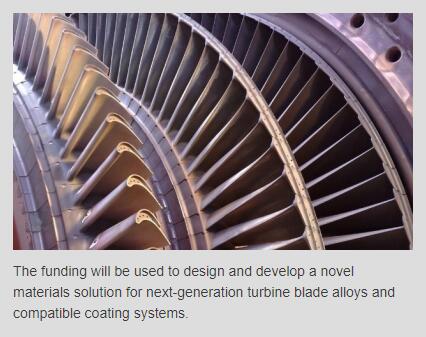
QuesTek Innovations LLC recently announced that it was awarded $1.2 Million in funding from the U.S. Department of Energy’s Advanced Research Projects Agency-Energy (ARPA-E). The funding will be used to design and develop a novel materials solution for next-generation turbine blade alloys and compatible coating systems. QuesTek will design a system of functionally-graded Niobium-based alloys suitable for Additive Manufacturing and that will be capable of sustaining high temperature operation and thus increasing fuel efficiency.
Dr. Dana Frankel, QuesTek’s manager of design and product development, stated “Designing a new turbine material with significantly better performance than current nickel-based superalloys is one of the biggest challenges facing the field of materials science today.” She added, ”We’re excited for this opportunity to apply our proven computational materials design approach to develop a new refractory turbine alloy, paving the way for a step-change in turbine engine performance and efficiency.”
QuesTek will apply its Integrated Computational Materials Engineering-based models and extensive experience in design of superalloys, refractory alloys, high entropy alloys, and coatings to design a printable niobium-based multi-material alloy system. Concurrent design of material and component, with the goal of accelerating adoption of the designed materials into next-generation engines, will be achieved by teaming with leading turbine engine OEM Pratt & Whitney to define aerospace requirements, perform component design, and guide testing and qualification. Furthermore, the project team includes NASA Jet Propulsion Laboratory for AM process development, and the University of Minnesota for coating development.
QuesTek received this competitive award from ARPA-E’s ULtrahigh Temperature Impervious Materials Advancing Turbine Efficiency (ULTIMATE) program, to develop and demonstrate ultrahigh temperature materials that can operate in the high temperature and high stress environments of a gas-turbine blade.
This effort directly addresses the need to improve gas turbine efficiency for aerospace and energy applications (e.g., ground-based industrial gas turbines), critical for increasing fuel economy and decreasing carbon emissions. Engine efficiency is fundamentally determined by maximum cycle temperature, and thus scales directly with the operating temperature. However, current state-of-the-art superalloys have limited high-temperature stability.
1.The news above mentioned with detailed source are from internet.We are trying our best to assure they are accurate ,timely and safe so as to let bearing users and sellers read more related info.However, it doesn't mean we agree with any point of view referred in above contents and we are not responsible for the authenticity. If you want to publish the news,please note the source and you will be legally responsible for the news published.
2.All news edited and translated by us are specially noted the source"CBCC".
3.For investors,please be cautious for all news.We don't bear any damage brought by late and inaccurate news.
4.If the news we published involves copyright of yours,just let us know.



Next Baldor Enhances Same-Day Gearbox Assembly Operations
BRIEF INTRODUCTION
Cnbearing is the No.1 bearing inquiry system and information service in China, dedicated to helping all bearing users and sellers throughout the world.
Cnbearing is supported by China National Bearing Industry Association, whose operation online is charged by China Bearing Unisun Tech. Co., Ltd.
China Bearing Unisun Tech. Co., Ltd owns all the rights. Since 2000, over 3,000 companies have been registered and enjoyed the company' s complete skillful service, which ranking many aspects in bearing industry at home and abroad with the most authority practical devices in China.


