X-ray vs metal detector: Improving inspection in the food industry
Phil Brown discusses dealing with different product densities and the use of x-ray and metal detectors
There are two distinct components to metal detection: magnetic permeability and conductivity. Most food products will leave a ‘fingerprint’ that combines elements of both, though the overriding component is likely to be conductivity. Metals also exhibit tell-tale combinations of both types of effect. For example, the majority of ferrous metals display stronger magnetic permeability, while non-ferrous metals will signal higher conductivity. Indicators for stainless steel, on the other hand, can easily be swamped by product effect.
With an x-ray machine, light waves pass through the product to be inspected. Because of this, products of differing densities impact an x-ray’s performance. To put this into context, consider a box of cereal, as an example. Although an x-ray machine will be calibrated for the product’s total density, cereal ingredients, raisins and bran for example, have variable densities. Speckles of raisin will be quite high, the bran low and the box they’re in, the same density. As the x-ray is measuring the collective density, if there’s a contaminant in the box and the machine lands on a low-density bran flake, it may not detect the sample in the same way it would when landing on a higher density raisin.
Similarly, there will be a different response if an odd-shaped piece of metal passes through a machine in different directions. This is why spheres are used to test a metal detector – it reflects the same amount of signal no matter where it’s pointing. Yet, flatten out the metal or roll it into a needle or wire shape, there will be a significant difference in signal, depending on how it passes through. This is due to the physics of how it’s breaking the lines in the field. The general rule is ‘if any of the dimensions are less than the detectable metal’s sphere size, the machine may have trouble detecting it’. Depending on the orientation in which it passes through, a bigger signal than the sphere may occur.
With an x-ray, the detection system – usually diodes – is underneath the light beam. If the product is very thin at its length and edge and small across the belt, even if the density is quite high, it may not be detected. Equally, if it’s very thin and flat, such as stainless steel and ferrous metal blade shapes, the total density may be too small to detect. In these scenarios, a metal detector is the top performer.
And when it comes to drilling down to detail, the key detection factor is the size of the product in relation to the machine’s aperture. A metal detector’s abilities weaken as the aperture gets bigger, so there’s no problem with a small detector, i.e. pharmaceutical size down to 0.15mm, or larger inspection ranges between 2-4mm.
When looking for metal contaminants of all sizes, particularly low-density metals such as aluminium, a metal detector will outperform an x-ray. Yet, as the aperture size increases, the x-ray races ahead, picking up denser metals such as stainless steel.The larger the aperture on a metal detector, the larger the product and more power required.
X-ray performance when tackling larger products
If an x-ray is handling larger products, larger apertures and more power will be required. Where something bulky is passing through, such as a 50lb bag of flour or sugar with 6-8in of reasonably dense material, more power will be required to process it. On the plus side, these homogenous products have few density variations, so detection is relatively easy.
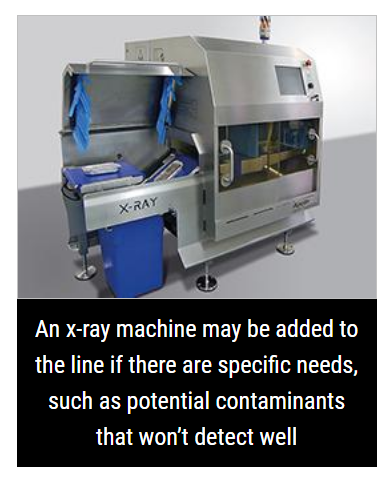
Metal detectors and x-rays are complementary technologies. If, after product risk analysis, you consider one is necessary, aim to have both. A metal detector should be a given and an x-ray machine added to the line if there are specific needs, such as potential contaminants that won’t detect well.
1.The news above mentioned with detailed source are from internet.We are trying our best to assure they are accurate ,timely and safe so as to let bearing users and sellers read more related info.However, it doesn't mean we agree with any point of view referred in above contents and we are not responsible for the authenticity. If you want to publish the news,please note the source and you will be legally responsible for the news published.
2.All news edited and translated by us are specially noted the source"CBCC".
3.For investors,please be cautious for all news.We don't bear any damage brought by late and inaccurate news.
4.If the news we published involves copyright of yours,just let us know.



Next Baldor Enhances Same-Day Gearbox Assembly Operations
BRIEF INTRODUCTION
Cnbearing is the No.1 bearing inquiry system and information service in China, dedicated to helping all bearing users and sellers throughout the world.
Cnbearing is supported by China National Bearing Industry Association, whose operation online is charged by China Bearing Unisun Tech. Co., Ltd.
China Bearing Unisun Tech. Co., Ltd owns all the rights. Since 2000, over 3,000 companies have been registered and enjoyed the company' s complete skillful service, which ranking many aspects in bearing industry at home and abroad with the most authority practical devices in China.


