Upgrading the grid for renewable energy
Francesco Ierullo discusses upgrading the grid to accommodate renewable energy
In its Renewable Energy Sources and Climate Change Mitigation report, the International Panel on Climate Change (IPCC) highlighted that renewable energy has the capacity to displace greenhouse gas emissions from fossil fuel combustion, while simultaneously improving energy access. To use renewable energy to its full potential, electrical infrastructure must be updated to accommodate the increase in supply and transport power to where it’s needed. Using composites can improve renewable energy transmission across the grid.
Despite efforts to lower energy use, the rising population and economic growth are driving global energy demand. To balance global demand with clean energy use, we must invest in projects that enable increased use of energy from renewable resources. However, to accommodate a widespread use of renewables in infrastructure, the grid must be capable of meeting modern energy demands.
The problem with conductors for renewable energy
Renewable energy sources may be located far from where the generated energy is consumed. For example, the majority of wind power plants in Italy are based in the south of the country, but the nation’s industrial hub is located in the north. As a result, transmission and distribution infrastructure must be capable of carrying the additional load. Many of these power lines were installed decades ago and were not designed to accommodate the additional mix of modern energy sources.
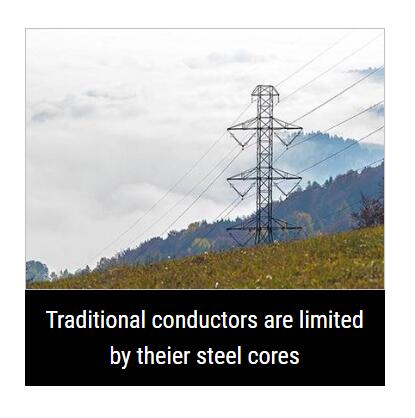
Traditional conductors consist of an outer aluminium conducting ring and a reinforcing steel core – known as aluminium conductor steel reinforced (ACSR) conductors. However, their current capacity is limited by the steel core that has a high coefficient of thermal expansion, meaning the heat from the current passing through the conductor and the ambient temperatures cause the steel to expand.
The result is a lengthening of the conductor between the tower supports, which causes thermal sag, where the conductor drops lower to the ground. This is exacerbated in older conductors that have a natural sag after being hung for decades. Sag that exceeds standards poses a safety risk and can lead to power outages, so these conductors must carry a lower current.
Despite the issues of the old conductors in the grid, many utility companies are reluctant to perform a complete replacement of tower infrastructure as it requires a great amount of labour, time and economic investment. This is particularly true in areas with uneven terrain, such as mountains where additional equipment such as helicopters may be required.
Renewable energy solution with composites
In place of a complete infrastructure replacement, ACSR lines can be upgraded to composite cored conductors, which have a lower coefficient of thermal expansion, allowing the conductor to carry over twice the amount of current. The high strength-to-weight ratio of composites translates into a higher tensile strength, which allows the conductor to be pulled tighter. Composite cores are more lightweight than steel, allowing more conducting aluminium in the conductor and therefore increased transmission capacity.
The upgrade is significantly cheaper than total grid replacement, as it can reuse the existing pylon and tower infrastructure. The process is also substantially quicker, which minimises disruption to energy supply. Additionally, if the composite-cored conductors are used in a new area where the electrical infrastructure must start from scratch, the high current capacity allows the tower count to be reduced.
Exel Composites manufactures strong and lightweight composite cores with a low coefficient of thermal expansion. The cores have performed strongly in accelerated ageing testing with minimal reduction in performance, and the company can work with utilities to respect their testing needs. Carbon fibre composite cores are produced using cost-efficient continuous manufacturing processes of pultrusion and pull-winding, and can be spooled kilometres at a time to keep production costs low, while ensuring consistent quality.
Renewable energy will play a crucial role in mitigating climate change and provides the opportunity to improve energy supply. Upgrading older power lines from steel cored conductors to composite alternatives will increase the current capacity of the grid, transporting renewable energy efficiently from generation to end use – helping to power the future.
1.The news above mentioned with detailed source are from internet.We are trying our best to assure they are accurate ,timely and safe so as to let bearing users and sellers read more related info.However, it doesn't mean we agree with any point of view referred in above contents and we are not responsible for the authenticity. If you want to publish the news,please note the source and you will be legally responsible for the news published.
2.All news edited and translated by us are specially noted the source"CBCC".
3.For investors,please be cautious for all news.We don't bear any damage brought by late and inaccurate news.
4.If the news we published involves copyright of yours,just let us know.



BRIEF INTRODUCTION
Cnbearing is the No.1 bearing inquiry system and information service in China, dedicated to helping all bearing users and sellers throughout the world.
Cnbearing is supported by China National Bearing Industry Association, whose operation online is charged by China Bearing Unisun Tech. Co., Ltd.
China Bearing Unisun Tech. Co., Ltd owns all the rights. Since 2000, over 3,000 companies have been registered and enjoyed the company' s complete skillful service, which ranking many aspects in bearing industry at home and abroad with the most authority practical devices in China.
