Overview of the Economic Performance of China Machinery Industry in the First Half of 2025
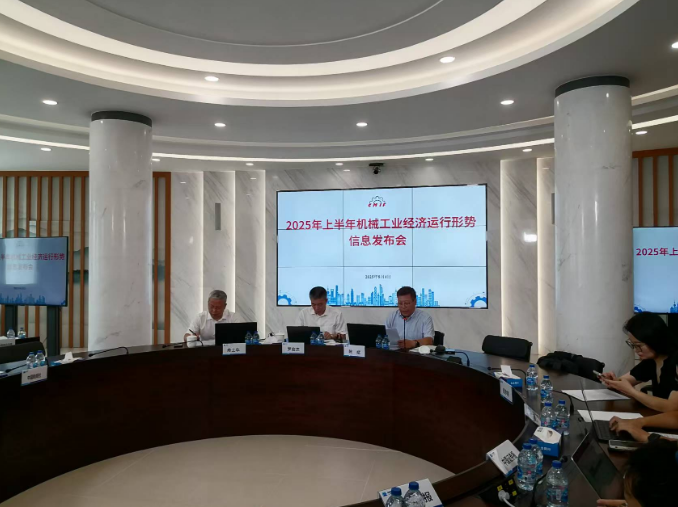
On August 4, 2025, the China Machinery Industry Federation held a press conference in Beijing on the economic performance of the machinery industry in the first half of 2025. Luo Junjie, Vice President of the China Machinery Industry Federation, released the economic performance of the machinery industry in the first half of 2025. The press release is published below for your reference.
Innovative Development Vitality Strengthens, Economic Performance Maintains Stability and Improves
—A Summary of the Machinery Industry's Economic Performance in the First Half of 2025
In the first half of the year, facing a more severe and complex external environment, under the strong leadership of the Party Central Committee with Comrade Xi Jinping at its core, the machinery industry conscientiously implemented the decisions and deployments of the Party Central Committee and the State Council, adhered to the general principle of seeking progress while maintaining stability, withstood pressure, faced challenges head-on, taken proactive actions, and forged ahead with courage, effectively addressing risks and challenges. The economy maintained stability and improved, with steady growth in product production and sales, resilience in foreign trade, accelerated unleashing of innovative vitality, active development of new-quality productivity, and significant results in industrial upgrading and high-quality development.
Looking ahead to the whole year, strategic opportunities and risks and challenges coexist, and uncertainties and unpredictable factors increase. However, the continued implementation of macroeconomic and industrial policies and the accelerated implementation of various reform measures will continue to benefit the operation and development of the machinery industry. The entire industry is confident in navigating risks and challenges and maintaining a stable and improving performance.
I. Basic Characteristics of Industry Operations
Data from the National Bureau of Statistics show that the machinery industry saw a strong start and positive momentum in the first quarter. In the second quarter, the industry experienced some fluctuations due to external factors such as US tariffs, but overall it remained stable and resilient. Key economic indicators for the machinery industry saw rapid growth in the first half of the year, laying a solid foundation for achieving full-year targets.
(I) The Industry's Pillar Status Consistently Enhanced
As of the end of June, the number of enterprises above designated size in the machinery industry reached 136,000, an increase of 6,000 from the same period last year, accounting for 26.2% of the national industrial total, a 0.4 percentage point increase. Total assets reached 40.4 trillion yuan, a year-on-year increase of 6.6%, accounting for 22.0% of the national industrial total, a 0.3 percentage point increase.
(II) Stable Growth in Added Value
In the first half of the year, the added value of enterprises above designated size in the machinery industry increased by 9.0% year-on-year, outpacing the national industrial and manufacturing sectors by 2.6 and 2 percentage points, respectively. This played a positive role in stabilizing the overall economy and boosting the industrial economy. The added value of the five major sectors of the national economy involved in the machinery industry all achieved year-on-year growth. Among them, the automobile and electrical machinery industries achieved double-digit growth, with increases of 11.3% and 12.2%, respectively, leading the growth of the machinery industry. The general equipment, special equipment, and instrumentation industries saw growth rates of 8.3%, 3.8%, and 7.6%, respectively.
(III) Product Production and Sales Stable and Improving
Thanks to the combined effects of existing stock policies and the intensified and expanded "two new" policies, domestic market demand improved, driving overall better production and sales in the machinery industry than in the previous year. In the first half of the year, of the 122 major products under key monitoring, the output of 84 products increased year-on-year, accounting for 68.9%, a 7.4 percentage point increase over the same period last year; the output of 38 products decreased year-on-year, accounting for 31.1%.
The main characteristics of key product production and sales are as follows: First, automobile production and sales maintained stable growth. In the first half of the year, automobile production and sales reached 15.621 million and 15.653 million units, respectively, representing year-on-year increases of 12.5% and 11.4%, respectively. Second, the production and sales of electrical and electrical related products were strong. In the first half of the year, generator set production increased by 60.5% year-on-year, while solar cell production increased by 18.2%. Representative products in the power transmission and distribution sector, such as transformers, high-voltage switchgear, and wire and cable, showed strong growth. Third, processing equipment continued its upward trend, with a clear trend toward intelligent upgrades. The output of metal-cutting machine tools, metal-forming machine tools, and industrial robots increased by 13.5%, 10.4%, and 35.6%, respectively. CNC machine tools saw faster growth than the overall market, and industrial automation control systems saw rapid growth. Fourth, the construction machinery market remained generally stable. In the first half of the year, cumulative excavator sales reached 121,000 units, a year-on-year increase of 16.8%, with domestic sales increasing by 22.9%. Fifth, agricultural machinery production slowed overall, with harvesting machinery experiencing a slight seasonal increase. Sixth, production of products such as metallurgical equipment, petrochemical equipment, and environmental protection equipment fluctuated due to adjustments in user industries.
(IV) Slow Growth in Fixed Asset Investment
According to data from the National Bureau of Statistics, fixed asset investment in the machinery industry grew by 3.8% year-on-year in the first half of the year. While higher than the national investment growth rate of 2.8%, it was lower than the average for the industrial sector (10.3%) and the manufacturing sector (7.5%) during the same period. Investment in the five major sectors of the national economy primarily involved in the machinery industry showed significant divergence. Investment in the general equipment and automobile industries grew by 16.6% and 22.2%, respectively, representing the "twin engines" driving growth in machinery industry investment. Investment in the special equipment industry grew by 6.2%, remaining stable. Investment in the electrical machinery and instrumentation industries declined by 7.8% and 15.6%, respectively.
(V) Economic Performance Stabilized and Improved
In the first half of the year, enterprises above designated size in the machinery industry achieved operating revenue of 15.3 trillion yuan, a year-on-year increase of 7.8%, 5.3 percentage points higher than the national industrial growth rate. Total profits reached 791.21 billion yuan, a year-on-year increase of 9.4%, 11.2 percentage points higher than the national industrial growth rate. Operating revenue and total profits accounted for 22.9% and 23.0% of the national industrial sector, respectively, up 1.1 and 2.4 percentage points year-on-year. The operating income profit margin was 5.2%, 0.1 percentage point higher than the same period last year, slightly higher than the national industrial average.
(VI) Business Climate Index Stable and Improving
The business climate index for the machinery industry remained within the booming range in the first half of the year, showing steady growth and overall performance better than the previous year. In June, the business climate index for the machinery industry was 106.9, 3.9 points higher than the same period last year, indicating that the industry's overall economic performance was stable and improving. Five of the six sub-indices were above the critical value. The product index was 105.9, 3.5 points higher than the same period last year, reflecting continued positive momentum on the production side. The industry index was 109.4, 3.9 points higher than the same period last year, reflecting continued positive development in the industry. The investment index was 109.4, 0.1 point lower than the same period last year, reflecting a continued slowdown in investment at a high level. The foreign trade index was 104.2, 0.9 point higher than the same period last year, reflecting the resilience of foreign trade amidst a severe and complex external environment and increasing uncertainty. The economic efficiency index was 107.0, 11.7 points higher than the same period last year, reflecting a significant improvement in the industry's economic performance. The price index was below the critical value of 98.1 and was 0.1 point lower than the same period last year, reflecting that product prices are still in a downward channel.
II. Highlights in Industry Development
In the first half of the year, the machinery industry adhered to scientific and technological innovation and green development, accelerating the promotion of new industrialization and industrial transformation and upgrading. Innovative vitality was unleashed at a faster pace, new momentum and new advantages continued to grow, and positive results were achieved in high-quality development.
(I) The Driving Role of Emerging Industries Strengthened
The driving role of strategic emerging industries in the development of the machinery industry continued to strengthen. In the first half of the year, the combined operating revenue and total profit growth of strategic emerging industries in the machinery industry exceeded that of the entire machinery industry by 1.3 and 5.4 percentage points, respectively. They accounted for 82.8% and 82.6% of the machinery industry, respectively, an increase of 1 and 3.9 percentage points year-on-year. Among them, the operating revenue and total profit growth rates of related industries such as new energy equipment, energy-saving and environmental protection equipment, and high-end equipment manufacturing were significantly higher than the overall machinery industry.
(II) The Pace of Green Transformation Continues to Accelerate
The new energy vehicle market maintained rapid growth. In the first half of the year, production and sales of new energy vehicles reached 6.968 million and 6.937 million units, respectively, representing year-on-year increases of 41.4% and 40.3%, respectively. The market penetration rate reached 44.3%, a record high for the same period. Clean energy equipment is developing rapidly, supporting the construction of a new energy system. In the first half of the year, wind turbine production grew by over 70%, accounting for over half of total generator set production. Wind and photovoltaic power generation accounted for 89.9% of newly installed power generation capacity. The green transformation of traditional industries has achieved remarkable results. Electric forklift production accounted for 77.1% of all forklifts in the first half of the year, and electric loader sales accounted for 25.4% of all loader sales in June.
(III) Foreign Trade Exports Maintained Rapid Growth
In the first half of the year, facing a more severe and complex international environment and foreign trade situation, the machinery industry withstood the pressure and responded effectively, achieving stable growth in foreign trade and demonstrating resilience. According to customs data, in the first half of the year, the machinery industry achieved a total import and export volume of US$597.6 billion in goods, a year-on-year increase of 7.1%. Imports amounted to US$131.66 billion, a year-on-year decrease of 8.2%, while exports amounted to US$465.94 billion, a year-on-year increase of 12.4%. The industry achieved a trade surplus of US$334.28 billion, a year-on-year increase of 23.3%, accounting for 57.1% of the national trade surplus in goods.
Looking at trading partners, the machinery industry maintained double-digit growth in exports to major economies. Exports to Belt and Road countries increased by 23.9% year-on-year, exports to RCEP countries increased by 16.7%, exports to EU countries increased by 12.3%, and exports to ASEAN countries increased by 24.2%. Among key trading partners, exports to the United States reached US$47.05 billion, a year-on-year decrease of 3.3%; exports to Russia reached US$20.29 billion, a year-on-year decrease of 18.2%. Exports to Germany (11.6%), Japan (2.0%), and South Korea (5.3%) maintained steady growth; and exports to Southeast Asian countries such as Vietnam, Thailand, and Indonesia grew by over 20%.
(IV) Significant Achievements in Major Technological Equipment
In recent years, the machinery industry has focused on the needs of high-quality development in energy, transportation, and chemical industries, actively promoting collaborative innovation and conducting joint research. In the first half of the year, a number of major technological equipment achieved new breakthroughs, addressing bottlenecks and providing solid equipment support for major project construction and industrial chain security. From power generation, grid-load-storage systems to fourth-generation nuclear power, the entire energy and power industry chain has achieved independent control. The world's first 700-megawatt ultra-supercritical circulating fluidized bed coal-fired power generation unit went into operation, pushing the efficiency of traditional coal-fired power units to a new level and marking a major breakthrough in my country's clean coal power equipment sector. China's first F5 gas turbine project with a high domestic content rate went into operation, marking the successful application of my country's independently developed F5 heavy-duty gas turbine. Breakthroughs were achieved in the development of the world's largest single-unit Pelton turbine runner and China's first 300-megawatt variable-speed pumped storage unit, breaking the long-standing foreign technology monopoly and establishing a collaborative innovation paradigm of "hydropower + pumped storage." The four nuclear main pumps of the Linglong-1 reactor, the world's first, were accepted and delivered. The world's only fourth-generation nuclear energy technology, a thorium-based molten salt reactor, was completed and is operating stably, forming a dual-track technology path of "third-generation pressurized water reactors + fourth-generation new reactors," ushering in a new era for fourth-generation nuclear power technology. The world's largest single-unit power, a 17-megawatt direct-drive floating offshore wind turbine, rolled off the production line, marking a new breakthrough in my country's deep-sea wind power equipment manufacturing. This enhanced equipment capabilities under extreme operating conditions. The ±800 kV UHVDC transmission line between the upper reaches of the Jinsha River, the world's highest altitude, and Hubei Province has been completed, as has the ±800 kV UHVDC transmission line between Hami and Chongqing, demonstrating the global leadership of power transmission equipment and technology in plateau and Gobi environments. China's first roller cutter rock tunnel boring machine (TBM) has been commissioned, and the world's first variable-diameter inclined shaft tunnel boring machine (TBM) has successfully penetrated a 50-degree inclined shaft, respectively solving two world-class challenges: hard rock tunneling and complex inclined shaft construction. These achievements provide equipment support for major strategic projects in my country, such as deep mineral resource development and pumped hydropower storage.
III. Difficulties in Industry Operations
In the first half of the year, the machinery industry faced an increasingly complex and challenging environment. The industry still faces difficulties and challenges, and the foundation for a stabilizing and positive recovery remains to be established.
(I) Tightening External Environment and Increasing Uncertainty
The global security situation is severe and complex. Geopolitical conflicts have erupted and recurred in multiple areas. The Russia-Ukraine conflict continues to drag on, tensions in the Middle East remain high, and the game between various parties has intensified. Disputes in the India-Pakistan region persist, and new destabilizing factors have emerged in areas surrounding my country. International trade is under pressure and facing increasing uncertainty. Since the beginning of this year, the United States has continuously wielded tariffs and implemented unilateral trade protectionist measures, which have continued to intensify the impact on the global economic and trade situation and supply chains. Future tariff policies remain highly uncertain. These factors have compounded and multifaceted impacts on the machinery industry's foreign trade. According to company feedback from a special survey, foreign buyers have become more cautious in placing orders since the second quarter, and companies face multiple risks in accepting orders, including tariff disruptions and exchange rate fluctuations. Stabilizing foreign trade faces pressure in the second half of the year.
(II) Demand faces downward pressure and needs to be consolidated
Affected by multiple factors, market demand has fluctuated, and the stabilization trend still needs to be consolidated. July's manufacturing PMI remained below the critical value for four consecutive months, with the backlog and new export order indices remaining below the critical threshold at low levels. Machinery companies are also facing insufficient orders. While cumulative order volume from key machinery industry companies maintained growth in the first half of the year, the growth rate has declined significantly compared to the beginning of the year and the same period last year. In particular, orders in petrochemical general machinery, heavy mining machinery, agricultural machinery, and instrumentation industries have all seen a significant decline. In the special survey, 66% of companies reported insufficient orders, with a decline in the growth rate of backlog orders, a preponderance of short-term orders, and a contraction in export orders all further exacerbated.
(III) Prices Continue to Decline, and the Task of Addressing Involution is Heavy
In recent years, machinery product prices have continued to decline. Since 2023, the decline in the ex-factory price index for machinery products has fluctuated around 2%. This year, the price situation in the machinery industry has remained severe. From March to May, ex-factory prices fell by 2.1%, and in June by 2%, marking 29 consecutive months of year-on-year decline. Ex-factory prices in the five major sectors of the national economy involved in the machinery industry all declined year-on-year.
(IV) Large Accounts Receivable and Long Collection Periods
As of the end of June, total accounts receivable in the machinery industry reached 9.3 trillion yuan, a year-on-year increase of 9.4%, accounting for 35.0% of the national total industrial accounts receivable. The average collection period for accounts receivable was 105.3 days, 35.5 days longer than the national average. By industry, the growth rate of accounts receivable in the internal combustion engine, electrical appliance, mechanical basic components, robotics, and intelligent manufacturing sectors exceeded the average growth rate of the machinery industry. The average collection period for accounts receivable in the construction machinery, heavy mining, and instrumentation sectors exceeded 130 days. A special survey showed that in the first half of the year, 53.4% of companies saw year-on-year increases in total accounts receivable, 42.5% saw increases in overdue accounts receivable, and 39.9% saw year-on-year increases in total bills receivable.
IV. Forecast for the Machinery Industry in the Second Half of the Year
Looking ahead to the second half of the year, the machinery industry still faces numerous risks and challenges, including insufficient domestic demand and unstable external demand. Externally, the international environment is generally tightening, geopolitical conflicts are frequent, tariff wars are intensifying, and trade uncertainty is increasing. Global economic growth is declining, international market demand is shrinking, and international organizations have lowered their forecasts for global economic and trade growth. The US-initiated trade war continues to evolve, and there is significant uncertainty about the future trajectory of tariffs between China and the US, as well as US tariff policies towards other trading partners. Domestically, the adverse impact of changes in the external environment is increasing, with market volatility, insufficient effective demand, and pressure on foreign trade exports. Structural contradictions in some industries are becoming more prominent, price inflation is squeezing profit margins, and difficulties in collecting receivables are increasing operating pressure, leading to operational difficulties for some companies.
At the same time, it is also important to note that macroeconomic and industrial policies continue to strengthen and intensify. From the Central Economic Work Conference to the Politburo meeting, policies and measures favorable to the machinery industry have been continuously released. Macroeconomic policies have become more proactive, effective, and sustained, with timely reinforcement. The "two new" policies have been expanded and improved, promoting high-quality development of the "two heavy" sectors. The issuance and use of government bonds have been accelerated, with increased support for scientific and technological innovation, consumption, small and micro enterprises, and foreign trade. The Ministry of Industry and Information Technology will soon issue a work plan to stabilize growth in the machinery, automobile, and power equipment industries, focusing on improving high-quality supply capacity, optimizing the industry's development environment, and promoting effective qualitative improvement and reasonable quantitative growth. Objective analysis shows that the supporting conditions and fundamental trends for the long-term positive growth of the machinery industry have not changed. The advantages of the machinery industry, such as its stable foundation, strong resilience, and great potential, remain unchanged. The industry's internal driving force remains strong, and the certainty of achieving high-quality development in the machinery industry continues to increase.
Overall, the machinery industry faces both strategic opportunities and risks and challenges, with favorable conditions outweighing unfavorable factors. Overall, it is expected that the overall economic performance of the machinery industry will continue to be stable and improving in the second half of the year, with major economic indicators growing at around 5.5% for the whole year and foreign trade remaining basically stable.
In the second half of the year, the machinery industry will continue to adhere to the guidance of Xi Jinping Thought on Socialism with Chinese Characteristics for a New Era, fully implement the spirit of the 20th National Congress of the Communist Party of China, the Second and Third Plenary Sessions of the 20th Central Committee, thoroughly implement the arrangements of the Central Economic Work Conference and the Political Bureau of the Central Committee, maintain strategic determination, enhance confidence in victory, insist on taking action as the top priority, actively respond to challenges, overcome difficulties, work hard, concentrate on doing its own thing well, fully and accurately implement the new development concept, accelerate the construction of a new development pattern, adhere to the leadership of scientific and technological innovation, accelerate industrial upgrading, cultivate and strengthen new quality productivity, solidly promote high-end, intelligent, green and integrated development, vigorously promote industry self-discipline, solidly promote new industrialization, strive to improve the resilience and security level of the industrial chain and supply chain, vigorously promote domestic and international dual circulation, respond to external uncertainties with the certainty of high-quality development, achieve a successful conclusion of the "14th Five-Year Plan", lay a solid foundation for a good start to the "15th Five-Year Plan", and contribute greater strength to promoting high-quality development of the machinery industry and building a manufacturing power.
1.The news above mentioned with detailed source are from internet.We are trying our best to assure they are accurate ,timely and safe so as to let bearing users and sellers read more related info.However, it doesn't mean we agree with any point of view referred in above contents and we are not responsible for the authenticity. If you want to publish the news,please note the source and you will be legally responsible for the news published.
2.All news edited and translated by us are specially noted the source"CBCC".
3.For investors,please be cautious for all news.We don't bear any damage brought by late and inaccurate news.
4.If the news we published involves copyright of yours,just let us know.



Next which type of bearings will be applied in the China latest super hydropower project in the lower reaches of the Yarlung Zangbo River
BRIEF INTRODUCTION
Cnbearing is the No.1 bearing inquiry system and information service in China, dedicated to helping all bearing users and sellers throughout the world.
Cnbearing is supported by China National Bearing Industry Association, whose operation online is charged by China Bearing Unisun Tech. Co., Ltd.
China Bearing Unisun Tech. Co., Ltd owns all the rights. Since 2000, over 3,000 companies have been registered and enjoyed the company' s complete skillful service, which ranking many aspects in bearing industry at home and abroad with the most authority practical devices in China.


