

Development of New OGL Technologies
Understanding the Importance of Base Oils and Polymers
Since OGLs rely heavily on base oil viscosity, the difference between viscosity improvers like, polyisobutylenes (PIB), polyalphaolefins (PAO) and unique performance polymers (UPP) needed to be better understood. We hypothesized that the UPP fluid would provide a lower coefficient of friction and better overall traction profile relative to the other base fluid types. Four base fluids were selected for a traction study and are highlighted in Table 3.
Component Mineral, weight PIB, % weight PAO, % weight UPP 40, % weight
Group II 600 N 100 80
Polyisobutylene 20
PAO-40 100
UPP 40 100
Kinematic viscosity at 40°C, cSt 117.6 454.4 428.7 420
Table 3—Base oils used for traction studies.
A base oil kinematic viscosity of 420 cSt at 40°C was targeted because of ease of testing. API Group II 600 N mineral oil was also selected as a baseline due to its inclusion in the PIB sample. Each of the oils was evaluated through MTM testing, which generated friction data at a range of slide:roll ratios. Each of the base fluids was loaded into the sample pot and was evaluated under the conditions shown in Table 4.
Test Parameter MTM Test Condition
Load, N 72
Average contact pressure, GPa 1.25
Speed, r/min 2500
Temperature, °C 140
Table 4—MTM test conditions for base oil traction studies.
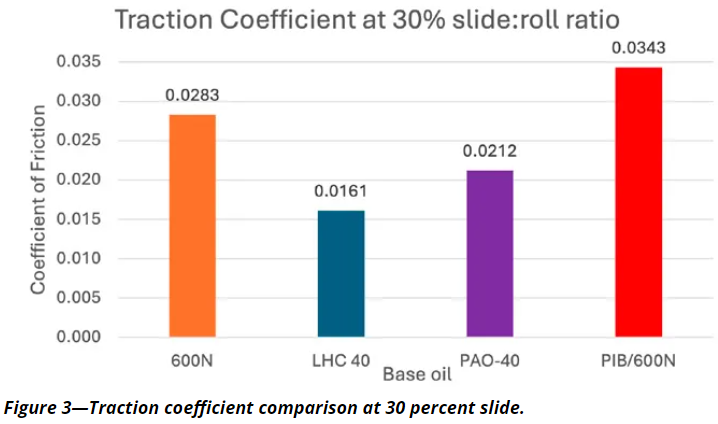
The temperature of 140°C was selected as a severe condition specifically to provide a worst case as a lubricant meshes between gears in field applications. Once each of the samples was loaded into the instrument, their traction coefficient was measured as the slide:roll ratio increased from 0–100 percent. Upon completion, traction coefficients were compared at a single slide:roll ratio and plotted in a bar graph (Figure 3).
Based on the base oil screen in Figure 3, it appears that treatment of the Group II 600N oil with polyisobutylene at even low weight percent, had a deleterious effect on the coefficient of friction. Given the OGL markets almost ubiquitous use of PIB as a viscosity improver, it is of no surprise that PIB-based OGL are not top-tier performing base fluids in industrial applications from a thermal perspective. PIBs have higher internal friction because of branching, which causes higher churning loss under fluid film lubrication, hotter running temperatures and lower efficiency. Based on industry knowledge, it was expected that the coefficient of friction would decrease when the PAO was used since it has lower internal friction during usage. Unlike the PAO, it was unclear how the UPP would perform in this study. Based on the results in Figure 3, the UPP provided the lowest coefficient of friction compared to the PAO which suggests that OGLs may see a boost in performance, especially at elevated temperatures, when UPP is used as the base fluid.
1.The news above mentioned with detailed source are from internet.We are trying our best to assure they are accurate ,timely and safe so as to let bearing users and sellers read more related info.However, it doesn't mean we agree with any point of view referred in above contents and we are not responsible for the authenticity. If you want to publish the news,please note the source and you will be legally responsible for the news published.
2.All news edited and translated by us are specially noted the source"CBCC".
3.For investors,please be cautious for all news.We don't bear any damage brought by late and inaccurate news.
4.If the news we published involves copyright of yours,just let us know.
BRIEF INTRODUCTION
Cnbearing is the No.1 bearing inquiry system and information service in China, dedicated to helping all bearing users and sellers throughout the world.
Cnbearing is supported by China National Bearing Industry Association, whose operation online is charged by China Bearing Unisun Tech. Co., Ltd.
China Bearing Unisun Tech. Co., Ltd owns all the rights. Since 2000, over 3,000 companies have been registered and enjoyed the company' s complete skillful service, which ranking many aspects in bearing industry at home and abroad with the most authority practical devices in China.
